
Episode 42: Women in our Art Museums
with art historian Sunday Rennie
Amy is joined by art historian Sunday Rennie to discuss the overlooked history of female artists, why they're underrepresented in museums, and what has to change for women to be seen as more than a muse.
Our Guest

Sunday Rennie
Sunday Rennie is a third-generation artist and seasoned art advisor. She holds a Master’s degree in Art Curating and has spent years immersed in Europe’s most prestigious art circles. With an innate eye for beauty and a deep understanding of artistic heritage, Sunday curates bespoke cultural experiences that offer guests privileged access to Paris’s vibrant art scene and hidden creative treasures. Learn more at savoirtours.com.
Amy Allebest: In the spring of 1985, the New York Museum of Modern Art launched an exhibition called “An International Survey of Recent Painting and Sculpture”. This exhibition claimed to survey that era's most important painters and sculptors from 17 countries. And on the roster of 165 artists, there were only 13 women. The proportion of artists of color was even smaller. One account puts the number at eight among 165. None of those artists of color were women. The Women's Caucus for the Arts led a protest across the street from MoMA, calling on people to boycott the exhibit. But their picketing was ignored, leading seven women to form a group that wanted to take more radical action to bring gender equity to the art world. They called themselves the Guerrilla Girls, spelled G-U-E-R-R-I-L-L-A from the Spanish word guerra, meaning war. But their members also embrace the way the word sounds in English, and they wear gorilla masks when conducting their demonstrations.
Periodically, the Guerilla Girls conduct “weenie” and “banana” counts wherein members visited institutions like the Metropolitan Museum of Art and counted nudes, noting the ratio of male to female subjects, as well as the ratio of male to female artists represented in the various collections. For example, data gathered from their survey in the Met in 1989 showed that women artists had produced less than 5% of the works in the modern art galleries, while 85% of the nudes were female. Today we're going to talk about patriarchy in the art world, drawing a long line before the Guerilla Girls, and going right up until the present day. To guide us on this fascinating and rather infuriating trajectory, I am joined by art historian Sunday Rennie. Welcome, Sunday!
Sunday Rennie: Thank you! Thanks for having me.
AA: I'm so excited to have this conversation. I'll just introduce our friendship by saying that we met in Paris a year ago in art museums, and you were such a fabulous guide, kind of a world-changing guide for my daughter and myself. It’s been so wonderful to be in touch since then, and I'm really excited to have our listeners learn from your expertise today.
SR: Thank you, again, for inviting me on your podcast. I'm very happy to be here and especially happy to discuss the issue of gender imbalance within the art market and art world in general.
AA: I'm very excited to get to it. But before we do that, I wonder if you could start us off by telling us a little bit about yourself, where you're from, the factors in your origins that brought you to do the work that you do today.
SR: I was suddenly born into the arts, one could say, because I was actually named Sunday after a very famous arts patron named Sunday Reed in Australia. And my grandmother, who happened to be an artist, a 20th-century artist within the Australian modern art canon, she named me after Sunday. She wanted me to be named after an intelligent woman that happened to be very heavily involved in the arts. So I wasn't named after the day, I was named after this woman, and very proudly so. My grandmother, Joy Peck, and my mother were both artists. And it's a bit of a tragic story, in a way, but she died for her passion. My grandmother was actually the first Australian artist to be invited to a little ceramic based town here in France called Limoges, and she would unfortunately die of esophagus cancer because of the inhalation of the fumes due to her enamel painting. And on her deathbed, I know it's kind of a tragedy, but on her deathbed she was like, “Sunday, what are you going to do when you grow up?” I was in my early twenties when this occurred, and I essentially said, “Don't worry, Joy, I'm going to become an art curator rather than an actual artist.” I happened to be studying my bachelor's in fine arts at the time, but I was very proud. I was like, “You don't need to worry about me. I'll be within the museum institutions.” I think she realized the difficulty of being in the arts and she didn't want to pass it on, but I said, “Well, you kind of started that off by naming me Sunday.”
I would go on to, funnily enough, do my honors thesis in internet art. And it was quite a new idea way back when, you know, of looking at how internet artists were criticizing knowledge and the status of society through knowledge through the internet. So that was quite an interesting time. I guess it's kind of dwindled down to that connection to fake news. I would then go on to complete my master's in art curating, and after I finished that, I moved straight to Paris. I needed to get to Paris, essentially. Since then, I've been working in institutions. I have worked for interior designers as well as for collectors building up collections. And today I find myself more in the private guiding world, so I’m very happily working on my own business within private tours of Paris.
AA: Fabulous, thanks for that introduction. I'm wondering, too, when you started becoming aware of gender issues, aware of patriarchy, either in your life or in the art world or both.
SR: Sorry to laugh, but I think since forever. I mean, I think it's always been quite evident. But within female artists, I suppose, you know, I've worked with several universities doing guest lectures and everything, and I think as far as I can remember, I've recognized the injustices. Maybe injustice is too strong a word or maybe it's not, but certainly the imbalance within representation of female artists. But more and more and more, especially because I actually work a lot at the Musée d'Orsay, at the Louvre, and so on, a lot of the time, and specifically at the Louvre, which is an institution that represents a large portion of art, everything from antiquity to 1848, I very, very, very rarely get the opportunity to show a female artist within that timeframe. Then I jump to the d'Orsay, which is a much smaller frame of time, and yet I typically only get to show one, maybe two female artists. And then again, at the Pompidou Center, which is kind of the third bracket of the main French institutions here, maybe one artist. And it's not to say that there are not female artists within that, but it's just that typically the representation is more geared, and even the curation of these institutions is more geared to male artists.
AA: It is so interesting to me too that going to all those major museums all over the world, you really are only seeing men. And that brings up the question for me, and I think we'll get to this later in the episode, but why is it? Because women artists throughout the ages weren't creating art because they were too busy raising families, they weren't allowed to go to art school, right? Is it that they were creating art but the male buyers weren't buying it, they weren't exhibiting it? I'm wondering what are some of the high level issues that create the situation where there just aren't women in the museums that you're teaching in.
SR: I think that there's a multitude of answers that we can come to in regards to that, and hypothesis as well. In the case of certain artists, certain female artists have actually been quite successful during their careers, Artemisia Gentileschi being one of them, who we can probably flesh out a little bit in a moment. But I think it's that adage that history is written by the winners, so female artists can often be written out of history. And again, I've got some examples to discuss about that. Writers and art historians tended to be male up until a certain time and fine arts academies tended not to actually accept women. And yes, a woman's place tended to be in the kitchen or with her children. So even when there was the talent, either there was an exceptional amount of talent that kind of surpassed that expectation or that reservation of women's roles of being in the kitchen or being the childbearer. And I suppose otherwise there was this kind of, “Well, you may be good but you're not that good” or this kind of attitude. And then you can even go a step further and say that the majority of curators, as well as art historians, tended to be male and also art dealers and also art collectors, even. You could go that far. So I suppose that's maybe an overarching reason for the lack not of female artists but a lack of presentation or representation of female artists.
AA: That makes sense. It seems like at every level of the structure, it was controlled by men and, and it still is in some ways, and, and we'll get to that, but maybe we can shift gears now and have you talk about some of the artists that did have success and really were world-class artists. Maybe talk about who they were, what their contributions were, and some of the challenges that they faced.
SR: So, remembering that I'm in the Paris space, a lot of my artists that I would like to discuss are European artists. And not to neglect the fact that there are a multitude of female artists out there, and even my perspective, coming from a white, Western, female perspective is certainly something to take into account. That being said, one of the artists that I'd like to touch on– there are several female artists I’d like to touch on, but one is a female impressionist artist named Berthe Morisot. She was actually born around the same time as Monet, as an example, and she and her sister were both very fortunate to have parents that were very understanding of her talents, let's say. They would actually allow for private tutoring, so she was trained in a kind of academic sense. And then one day she was at the Louvre and she would meet Manet whilst copying a Velázquez painting at the Louvre, and they would set up this kind of a muse/model-lover relationship.
Now, for whatever reason, Berthe would go on to marry Édouard Manet's brother, Edgar (Eugène). And we don't know, maybe it was something arranged between the two, but essentially Edgar, the kind of lesser known Manet, would actually be very supportive of Berthe. They had a child together, Julie Manet, and through the ties that she made with the Manets, she would meet a bunch of the impressionists. She would actually participate between 1874 and 1886. She would participate in seven out of the eight impressionist salons, yet there are various reasons for the fact that she goes unnoticed today. I'm making a real effort when I'm showing people around the Musée d'Orsay to show off her work, because she's actually a real talent, it's not just because she's a female artist that I'm trying to show off her work. It's just incredible to see her brush work, her expression through color, and then to think that indeed her name is far less known than Monet, Sisley, Pissarro, and so on, very simply because she is a female artist.
And to trace it back to the origins, it's actually despite her having partaken and despite her being relatively highly regarded amongst her peers, the catalog writer of the impressionist salons decided, “Hmm, she's a woman. Therefore, I'm going to omit her name.” That's the beginning of the reason that Berthe Morisot is not well known. Her name is not well known today. I think it's only now that things are starting to change. And as an example, in 2018, the Barnes Museum in Philadelphia was the first to have a retrospective on her work. So now we're seeing a shift. Having worked in the museums for at least nine years now, I'm noticing personally an increase in the Morisots that are on display. It was like one or two, now I'm seeing five or six on display. So that exposure is a big thing to consider as well when it comes to women or female artists.
AA: That's amazing. I have to say, one thing I thought of just now is something that gives me hope and makes me really optimistic is that that can change. To your point that you're seeing more and more exhibitions of her work, it reminds me that that can change from one generation to the next, for example. I don't have this experience in the arts, but in literature, I had never heard the name Mary Wollstonecraft until I was probably in my thirties, and my daughters learned about her in elementary school. So once it catches on and somebody learns about a person's work and then they start talking about it, if they start talking about it to children, those children grow up with those people kind of populating the pantheon of great artists or scientists or whatever, and they grow up just thinking it's normal. So, it can change!
SR: Completely, yeah. And I would actually say that I personally feel like it is changing amongst younger generations, but also amongst institutions only now.
AA: I mean, since the Guerrilla Girls, that data that I shared at the beginning, it's changed a ton since then, it seems like.
SR: I feel like it's on the art market specifically. I know we're going to come to that later, but specifically on the art market, I'm seeing changes now. And also within curation as well, finally.
“her name is far less known than Monet, Sisley, Pissarro, and so on, very simply because she is a female artist...”
AA: Finally! Well, yes, we'll get to that in a few minutes, but tell us more stories. I loved the story of Berthe Morisot, so tell us about some other women that you love teaching about.
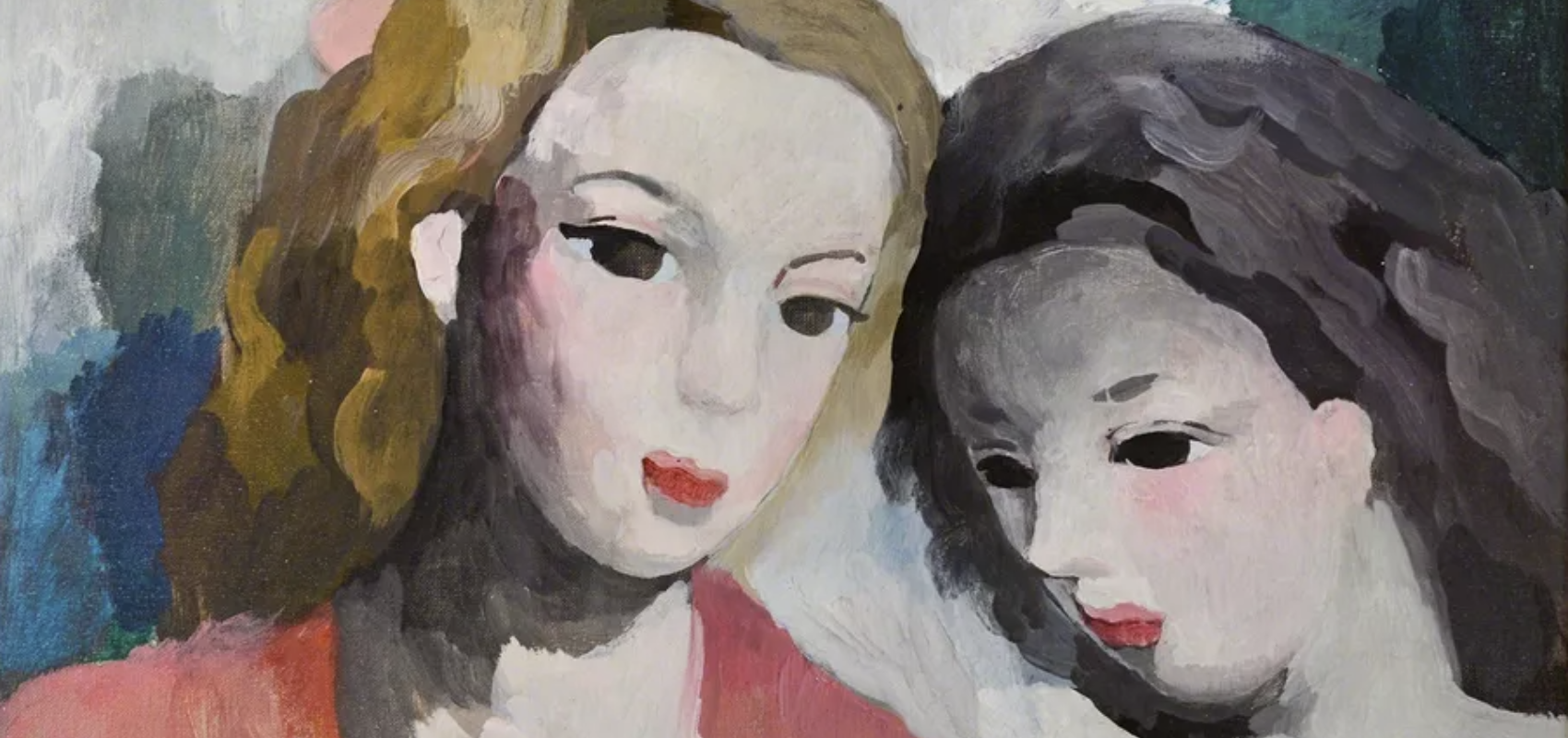
SR: Another artist would be Marie Laurencin, another French artist. Laurencin is a great artist to know. In fact, I have to say that I like components of her work, but she's not my favorite artist. That's something that I've noticed within the museum space, is, again, an effort to curate or to show, like recently at the Orangerie, another museum in Paris, to show some of the lesser known artists of their collection. Their collection's actually a really fascinating collection on its own, but that's for another time, just how they actually obtain the collection. But typically it's noted for holding works by Renoir, a great Cézanne collection, some beautiful Modigliani. And at present the Cézannes and the Renoirs are off in Milan, they've just lent them out, so the curators have started to show off Marie Laurencin, as well as Chaïm Soutine’s work, with Laurencin as the artist that I want to focus on. So, again, it’s really a pleasure to be able to show these works to my clients, because a lot of them haven't heard of either of these artists, like Chaïm Soutine, a Belarusian Jewish artist whose works are also incredible.
But to focus on Laurencin's works, the collection is thought to be one of the best collections in the world of her works. She actually was Paris-born and met Guillaume Apollinaire, whose name you might know of. He was a very famous French poet, but really in the art world at the time. But after she meets him, she would actually befriend people like Picasso, Picabia, Robert Delaunay, and so on. So she was really considered amongst her peers as being a great artist amongst these guys, the top 20th-century modern artists. And she would then marry a German man, and then during World War I she had to escape France because she was immediately considered German. And she moves to Spain, which is where her art evolves a little bit more into what some art historians have considered as being lipstick lesbian or, you know, really hypereffeminate colors, like pink fairy floss and pastel colors. What's interesting about that is that she was actually quite successful during her actual career. She was supported by the likes of Domenica Guillaume, who was the wife of Paul Guillaume, a very famous, reputable art dealer in Paris. And Domenica really pushed her art, so she was doing quite well. And then she even did a very famous portrait, which caused quite a scandal between her and Coco Chanel.
AA: Oh, interesting.
SR: Coco Chanel would kind of denounce Laurencin and Laurencin would denounce Coco Chanel as being a mere farm girl. But it was this funny thing because her career was doing quite well. And then after she passed, again, she was kind of written out of the history books in a way. And I think if you wanted to consider why that is, there's some certain reasons, because she's got this hyper effeminate, you know, lots of her paintings feature women in tutus. She even actually worked for the ballet at a time, and she's got this beautiful abstract painterly application in the background with certain cubist references. But because it also features a lot of animals, not only these dancers, but also lots of animals, little doves and kind of fantastical horses and things like that. Because of that, and because we're looking at an artist that's working around more time, a lot of art historians and art critics became critical of her posthumously, in the sense that she was just a little bit too effeminate. And what about abstract expressionism and modernism and, you know, wartime reactions and conceptualism. And so her work was considered just decorative.
And when I think about it, it's really quite funny, because you look at one of the most famous works in the world, which is Monet’s le grand decoration, his big decorations of the water lily pond that he installed at the Orangerie, in the same space that her works are on display. And one of the criticisms of his works is also that they were too decorative. And I could go on and alter the path of this podcast in terms of my defense of Monet's works. But to keep it more towards Laurencin’s works, I find it funny that despite that criticism of his works, that initial criticism of those beautiful water lilies, that Laurencin's career or reputation didn't bounce back quite as much as his. And that is maybe a question of curation, maybe of exposure, again, maybe of the fact that a lot of people that I show her works to just simply don’t know who she is, so there can't be a debate after all. People just simply don't know about her. So I think it's really a multitude of reasons that women artists are still being overlooked today.
AA: Yeah, that's so interesting. And I wonder if people hadn't known she was a woman, if they had just considered her works on their own, if they would've been able to accept them the way they do Monet's water lilies, and even Degas painted dancers and ballerinas in tutus.
SR: Yeah, I don't know. I think that there is this innate bias in a lot of people. I don’t know how to say it better. I often think about that comparison between Degas. I think Degas was a genius in different ways as well, but I think it's really interesting to do that comparison between Degas and Laurencin. Certainly Degas was attempting, in my opinion, to do different things. I think he was a compositional genius. However, in terms of that pretty decoration, those pastel colors, you could very much compare the two artists and wonder why it is that Degas has relatively– well, Degas struggled as well as an impressionist artist, but why Laurencin was written out...
AA: But Degas was selected for the canon, so he got to live on and she didn't.
There are a couple of other French artists, and I also want to make sure that you get back to Artemisia Gentileschi. She is one of the ones that I did learn about, not until graduate school, but one of my friends did a project or presentation on her, so I was quite fascinated. But yes, there are a couple more women artists that I'd love to hear you talk about.
SR: I would like to touch briefly on even my grandmother's career.
AA: Yes, please do.
SR: Again, her name was Joy Peck. She was actually quite a well-known artist. She received a lot of press at the time, even though some of that press, even recently looking over the art criticisms of my grandmother's works, that “she has this naive touch, but is it too fantastical?” “Is it too whimsical?” is one of those criticisms. And yeah, just to briefly comment on her life, she was very forward-thinking, very much respected among her peers. And once again, her career– and arguably, that's my family's fault because now I'm trying to make an attempt to catalog all her works that we still have in our family estate, and maybe put on a show. It's very ongoing. But just to bring back the discussion around her works, which are absolutely stunning, you look at her male contemporaries, specifically, who are still the most reputable names in Australia of that period of modern art. So even just to touch on that is quite interesting.
“it’s really a multitude of reasons that women artists are still being overlooked”
Who else did I have? Oh, Le Brun. Élisabeth Vigée Le Brun was an artist working in and around the period of Marie Antoinette, and she would actually catch the eye of Marie Antoinette, the queen of France. And as a female portraiture artist, she had this way about her of capturing something that perhaps Marie Antoinette had never received from a male artist, which was maybe a sense of understanding or a more delicate touch in the sense of understanding what it is to be a woman. Marie Antoinette is often, in my opinion, the scapegoat of the French Revolution, the poor thing. Not to declare that she was completely innocent, however, from the age of 14, she was married into this French royal family, she was immediately called “l'Autrichienne”, which is “the Austrian bitch”, literally from day one. So even that saying that she said “Let them eat cake,” that's complete propaganda against her.
So I feel like it's important to touch on Élisabeth Vigée Le Brun's career, but you could argue that perhaps she wouldn't have had a successful career had she not caught the eye of the queen. And in fact, there was a discussion between the two that Le Brun would paint a series of portraits of the queen in less formal attire. And when these were released, they were considered highly inappropriate, and yet it enables us to see a different viewpoint of somebody that was often perceived as being excessive, as being decadent, naive, and so on. And yet, one of the portraits that I love by Vigée Le Brun happens to be Marie Antoinette in a beautiful little blue gown, clipping a rose in a garden setting. Contemporary audience members really don't realize just how atypical that was for the time, how almost unacceptable it was. Because for the queen, you would only ever see her in a room with a crown next to her, in a beautiful gown, like an elaborate embroidered gown, rather than what was considered less formal attire.
So the fact that Vigée Le Brun had the understanding to maybe see beyond the expectations of the queen and also see beyond the mispresumptions of the queen was really quite something. I think that's where the two formed a bond, because perhaps Marie Antoinette felt more like a human being rather than this expectation as being queen. Luckily for Le Brun, despite a bit of scandal, her name became quite reputable simply because of that connection of being the queen's first chosen painter. But that meant that it was quite dangerous because towards the revolution she had to make the decision to escape France and would spend the rest of her career traveling around Europe until the completion of the first revolution. She very much traveled around entirely. And the same thing can be said for her career. She was very successful during her life, actually. But once again, I've only really seen her name, and again, maybe this is just my readings, but I've only seen her name pop up in conversation over the past maybe 20 years.
AA: If you're not hearing her or seeing her, then no one is.
SR: Maybe not.
AA: Yeah. I thought it was fascinating. That's so beautiful, her humanization of the queen and making her relatable as a woman, not as a scapegoat. That's so interesting. Who's next on our list?
SR: I love Gentileschi. I love a lot of the artists that I've actually discussed, but Gentileschi, I just adore her. First of all, you probably know her story already. She’s a very, very talented painter, and in my opinion, supersedes her father. Orazio Gentileschi was her father, working alongside Caravaggio, so around the Baroque Italy period of the early 1600s. And of course, well, not of course, but atypically, Orazio would train his daughter, Artemisia. So, Gentileschi. I’m excited to talk about her for two reasons. One, because I love her style, I love her name, and I'm really happy that, at least in universities, I feel like her name is being shown off a little bit more than it once was. And two, because of a personal story that I have with a recent Artemisia Gentileschi fascination I've developed over the past few years. Essentially, Gentileschi, her chiaroscuro– I'm a big fan of Caravaggio, and I think her chiaroscuro, which is that contrast between dark and light, I think is just divine. I think her work really, in terms of the art market, actually should be on par with the art market of Caravaggio, and I think that's slowly changing over the years.
Her personal story is actually, unfortunately, a very sad one. Which is that through her father's connections, there was actually another artist, Tassi, who would unfortunately rape Artemisia Gentileschi, and I believe she was in her early teens when this occurred. And despite her not wanting to go forward with claims against Tassi, her father, with his daughter's honor having been taken, he really pushed his daughter to go forward with accusations of rape. Unfortunately, at the time this meant that if you were to accuse somebody of rape, you would undergo a grueling interrogation, torture, and so on, just really determining whether it's true or not. You can really see what a tragic youth she endured and how difficult it would've been. And even though it is recounted that she was very stoic in her testimonial, it was a very difficult situation, one can only imagine. One hopes not to imagine.
It would make sense then that you can see this youth or this experience in her early years coming out a little bit in her paintings. Essentially, Artemisia Gentileschi’s most famous work is Judith Slaying Holofernes. In fact, she would actually execute at least two paintings, that we know of, of this depiction. One is of Judith in a blue dress, and the other is of Judith in a yellow dress. And who is Judith and who is Holofernes? Well, it's a very famous text, which depicts this idea of Judith, in order to protect her village that is under Assyrian attack, she enters Holofernes’s tent, who is the leader of the Assyrian army, and under the guise of seduction, she will allow for him to become drunk, and then whilst drunk, she beheads the Holofernes. So the idea is that she’s protecting, she's sacrificing, doing the unthinkable in order to protect her family and her village people. It's basically a story that has been reiterated during the Renaissance and during the Baroque period. It's not an uncommon subject matter.
Caravaggio would do at least one as well, a depiction of the same story. However, Caravaggio's version is a little bit less about the female perspective and more about the grotesque of Holofernes’s actual head being beheaded. Whereas the beauty of Artemisia’s versions, and I must admit they're actually a little bit more grotesque in the sense of the blood splatter. I believe the one at the Uffizi Gallery in Florence, the blood splatter onto her breasts, not in a sexual way, but onto her decolletage, let's say, is much more intense. You really get that this is an intense moment. You see it as not only the savagery, unfortunately, of his head, but you also see it in the sense of her experience as well as the servant's experience in assisting the horrible act. So, essentially within Gentileschi’s version, and really I'm talking about her most famous work, you can see this involvement of the two women within the story, the servant and Judith. And you can also see, I mean, you wouldn't say that she's enjoying this moment in time, there's almost a repulsion, but it's certainly more focused on the female experience or the woman's experience. But basically, the chopping off of the head, you can see the expression, you can see her repulsion as well as involvement in the scenario.
It's really interesting to see that female perspective within something often not seen when it's enacted or when it's recounted by male artists. What's interesting about this is, yes, we can understand where maybe some of her more violent subject matter comes from. I'm not saying I agree, but you can understand where that response from her youth experience might be coming from. What's interesting is actually a recent personal experience, which is that I went to a show that's a small retrospective at the Jacquemart-André Museum here in Paris with a friend. And the friend, it was just interesting to look at men's observations within the room and women's. There were a lot of women that were looking up close. And in fact, the friend that I happened to be with, a guy, ended up meeting me at the end of the exhibition and I was like, “Did you enjoy the show?” And he responded, “Yes, I did. However, I wonder whether audience members would be so compelled to see the Judith and Holofernes slaying scene if it were reversed.”
AA: Oh, wow.
SR: And I was like, “Well, I think so, because this isn't the first time that we've seen a violent occurrence towards a man. Nor is it the first time that audience members have reacted towards a woman.” But it was very interesting, because it is important to think about differing opinions towards her works. But I couldn't help but feel as though it was read in a different way. And maybe even my wrongdoing, which was that I hadn't mentioned that Caravaggio has done this exact same scene quite a few times as well, as well as many other Baroque artists. Baroque was very much about the drama and the theatre, so it makes sense that this is a theme that would be attacked by multiple different artists, including one that I know of female artists, amongst many other male artists. It was just interesting to see that reaction about the female artist. The question could be inverted and I could say, “Well, would you be so offended if this was painted by a male artist?” And that's just an interesting idea. I don’t know where I stand with it, and I totally understand and acknowledge my friend's response as well, but I just think it's an interesting thing to point out.
AA: Yeah, very interesting. I love hearing all of these stories about these remarkable women, and their art is incredible. I'll just tell listeners who are listening to the podcast, if you want to go to YouTube, we'll have images there. And on our website, also, and on Instagram, we'll put some images up there too so that you can actually see the paintings that Sunday's talking about. But thanks for telling us about all these remarkable women. I'm wondering now if we can fast forward along the timeline and have you tell us about contemporary female artists, because I'm curious if contemporary female artists are being recognized now.
“It’s really interesting to see that female perspective within something often not seen when it’s enacted or when it’s recounted by male artists.”
SR: I think that is the case. I think ever so slightly in the 21st century, we've seen an increase in representation of female artists. I think it's really changing now, specifically with young female artists in their twenties and thirties and maybe forties. It's really quite interesting to consider that– just a quick note on the 20th-century female artists versus their male counterparts, one of the most popular artists, or certainly the most successful in the art market, has been Yayoi Kusama, a Japanese artist who focuses on dots. And one of the reasons she's been most commercially successful is because of her associations with Louis Vuitton as a brand, so her integration of artwork within clothing and branding. But then you look at some of her male counterparts, and whilst Kusama, just to briefly touch on it, I don't want it to become an art market statistics thing.
But not at all that they're the same artist, but both born around the same period of time, Kusama in 1929 and David Hockney, he's having a major retrospective here at Fondation Louis Vuitton. I love his works, and he was born in 1937. So you compare her works around 80 million to his 90 million. And even just to give you more of a sense of that perspective. 13% of total global auction value was dedicated to female artists in 2023. And as an example, typically you'll see female artists breaking maybe 16, 20, 30 million max. There's always an exception, of course, but then you look at male counterpart artists and they're breaking 150 million. Again, there's a great disparity. And I don't think it's because there's a lack of talent.
AA: Yeah, certainly. Wow.
SR: So, for contemporary artists, one thing that's great is Marlene Dumas, another French artist, one of her works literally last week sold at an auction for I think 13.5 million euros, so that was record-breaking for a living female artist. She's certainly on the way up. There are also artists such as Jenny Saville, all of those famous names, Cecily Brown, another great example of contemporary 20th-century and 21st-century artists. And then you've got some of the young up-and-comers, which I really like to see. People like Flora Yukhnovich, Sarah Sze, again, I am terrible with the pronunciation of it. As well as some African American artists, such as, forgive my mispronunciation, but Tschabalala Self, whose works are really wonderful depictions of African American woman's life, done in this beautiful pictorial sense with references to her upbringing in Harlem in the background, and really beautiful self portraits as well. Or Yukhnovich’s works are commenting on, which I found really interesting, they're using a similar color palette that dates back to the rococo, and what did the rococo associate with? Feminine colors, such as pastels, as well as with Marie Antoinette. And yet she's kind of commenting on that art. It's an art historical kind of loop that's going on. I think it's really interesting to see that, yes, there is an evolving art market for female artists, but certainly still nothing to where male artists are sitting at.
AA: Yeah, that's really interesting. Thanks for mentioning all of those names. We'll have those in the show notes, too.
SR: Hopefully I pronounced them correctly.
AA: Better than I would've done. That's wonderful. Well, my last question for you is what listeners could do to improve the situation. What can we do to support women artists, to educate ourselves, and to keep this positive momentum going?
SR: That's great. What it comes down to is about creating a dialogue. I'm really happy that we're creating a bit of a dialogue today, or continuing a dialogue today. Maybe even Google searches. I think that there are algorithms, and the tech world is definitely not my thing, but the more people search for a female artist, maybe they'll become more prominent. If they're lucky enough to be art collectors, they could be trying to evolve their awareness of female artists and maybe collecting some of them, and I suppose that's a good start. And listening to more podcasts on female artists, for example.
AA: Fabulous. Yes, and again, I think it really did encourage me to hear throughout this conversation how things have changed and improved, albeit incrementally and sometimes in small increments. That it does improve, and the more people talk about it, even people just teaching art classes in their communities, choosing to focus on women artists so that the next generation grows up thinking of it as normal.
SR: Completely. Or even if you have the opportunity to go up to somebody and say, “Where are the Morisots?” And just to backtrack briefly, what I find really interesting with dialogue around female artists is that we often tend to call them by their first and last names. So sometimes I'm like, “Do I want to correct myself or do I still want to say Berthe Morisot or Marie Laurencin?” Does it actually point out that it's a female artist, and does that matter?
AA: Oh wow.
SR: It's just interesting that even dialogue surrounding female artists is entirely different.
AA: You're right. I hadn't thought of that. That's true. To say just their last name conveys status, doesn't it? Wow, I'm so glad you pointed that out! That's true. Well, Sunday Rennie, this has been a delight. Thank you so much for being here. I learned so much from you, and I'm wondering if you have any social media handles or anywhere that listeners can find your work.
SR: Yes, for sure. At present, I am offering private tours of museums and I specialize in certain artists such as Monet, as well as doing certain highlights of female artists within museums. So anybody that's interested in contacting me can contact me via savoirtours.com, or they can also contact me via Instagram @savoirtoursparis.
AA: Fabulous. And again, I can't recommend the tours highly enough. My daughter, Sophie, is an art history major in college and we had two fantastic days with Sunday in Paris last year, and we learned so much. So yes, I highly, highly recommend it if you're in Paris. Thank you. Thank you so much, Sunday! This has been wonderful.
SR: Yeah, for me too! I'm very happy to have hopefully exposed some new artists, some new names to people's repertoire.
